
Carson Hocevar’s inaugural Cup Series victory April 26 at the Jack Link’s 500 spurred an incredible rush for the Raced Win diecast commemorating his emotional win. Just a few hours after pre-orders opened, Lionel Racing’s website appeared to crash. Confirming the influx of orders, Lionel Racing announced Hocevar’s Raced Win diecasts had “FAR surpassed MOQ [Minimum Order Quantity] in all versions in less than 12 hours.”
The incredible response for Hocevar’s Raced Win can be attributed to many factors; his popularity, it was his first Cup Win, the dramatic nature of the final laps. But another key consideration is Raced Win diecasts, for many, are the ultimate expression of NASCAR diecast collecting.
Unlike “clean” versions, Raced Wins do not showcase how the car looked, pristine and polished, when it rolled off the hauler that weekend or in marketing photos weeks before the engine was fired. Rather, they commemorate a driver and team’s triumph over the field after hundreds of miles of racing, and each bit of damage, debris or decoration on the car are battle scars telling the story of that victory.
An artist behind the work
Many of the Raced Win diecasts dating back to the Car of Tomorrow era owe their design to Kevin Bluhm, Lionel Racing diecast artist. Bluhm studied graphic design in college, earning a computer animation and 3D modeling degree, before landing roles at headwear companies specializing in professional sports.
“When Lionel, then Motorsports Authentics, posted an opening for a headwear designer, I saw it as an opportunity to eventually transition into diecast where I could apply my technical background and 3D skill set more directly,” Bluhm said.
After two years designing headwear, Bluhm made the transition to diecasts, a role he’s enjoyed for 18 years.
“I grew up watching racing and have been developing my skills in digital art and 3D for nearly 30 years,” he said. “Being able to combine that background with a career centered on motorsports is something I don’t take for granted.”
When it comes to Raced Version/Raced Win diecasts, Bluhm said the process effectively hasn’t changed much over the last two decades. That includes designing all Raced Wins in 1/24 scale and applying that art to 1/64 versions as it’s far easier to scale down, he said.
Bluhm appreciates having a lot of design work on each car.
“I enjoy working on cars with a lot of damage, and more so from a technical aspect, if the car has both matte and gloss details in the finish,” he said. “It’s a double-edged sword, but the finished product always feels a bit more rewarding.
Unsurprisingly given that sentiment, heavily damaged cars are among the diecasts he’s most proud to have designed.
“In no particular order a few that come to mind are Justin Allgaier’s No. 40 Daytona 500 car, Ross Chastain’s “Hail Melon” Martinsville car, and one I recently completed the art for is Chase Elliott’s 2015 NAPA First Start Race Version,” he said.
Designing Raced Win diecasts are artistic endeavors, and as such, Raced Win diecasts are subject to criticism. There are YouTube and social media outlets dedicated to reviewing diecasts of all varieties, but Bluhm won’t be watching or following the comment sections on social media.
“I’ve learned not to read the comments,” he said. “A long time ago I realized you can’t please everybody. All you can do is the best job possible with the resources you have. Over the years, though, I’ve had the chance to meet several hardcore collectors in person, and the feedback has always been extremely positive. Those conversations have helped me stay focused on giving every project the same level of attention and care, regardless of the driver or the significance of the win.”
Bluhm’s work, no matter how it’s critiqued, effectively begins before the tires have had a chance to cool in Victory Lane.
Designing a Raced Win diecast
As the sunburned masses make their way to the parking lots and the race winner begins the “hat dance” — a series of pictures of the driver and his team wearing hats adorned with logos of various sponsors in Victory Lane — another dance is occurring surrounding the race-winning car. This unseen ballet is a photographer weaving among the crowds to take photos of the winning car, the first step in creating a Raced Win diecast.
Lionel Racing partners with Action Sports Photography, which is present at each NASCAR national series race. Matt Kenfield, Diecast Category Director for Lionel Racing, said ASP and Lionel have an agreement with NASCAR that provides unmatched access to a car in Victory Lane. As such, that photographer’s work, shared on Lionel Racing’s social media outlets as reference photos, becomes the basis for each Raced Win diecast.
“Our photographers take anywhere from 15 to 50 photos of every angle, nook, and cranny of the winning ride,” Kenfield said.
Sometimes these photographers are tasked with taking reference photos of other cars in the field to create Raced Version diecasts.
“Sometimes if a story is so crazy that it would make for a great Raced-Version diecast, we will send the photographers a text during or right after the race and they’ll [take] photos for us to use for the diecast,” Kenfield said. Some recent examples include Chastain’s “Hail Melon” and Kyle Larson’s 2025 Phoenix Raced Version in which he took the Cup Series title but not the race win.
It’s not an easy task, and it’s one that’s crucial, Bluhm said.
“The biggest challenge has always been winner’s circle reference photos, the quality of those can make or break us,” Bluhm said. “Unfortunately, with so many people circling the car the photographers have a difficult job of capturing all the angles we need to see all the details in the race damage.”

Once Bluhm or one of Lionel Racing’s other designers — there are four artists, and the designer selected for each Raced Win is based on a rotation and workloads — receive the photographs, the design work to develop the diecast begins.
The starting point is not always the same as sometimes the base car has already been designed. For example, Chase Elliott’s 2025 Kelley Blue Book diecast was already designed, so the base art was already completed when it came time to create his Kansas Raced Win diecast. Otherwise, the design begins from scratch.
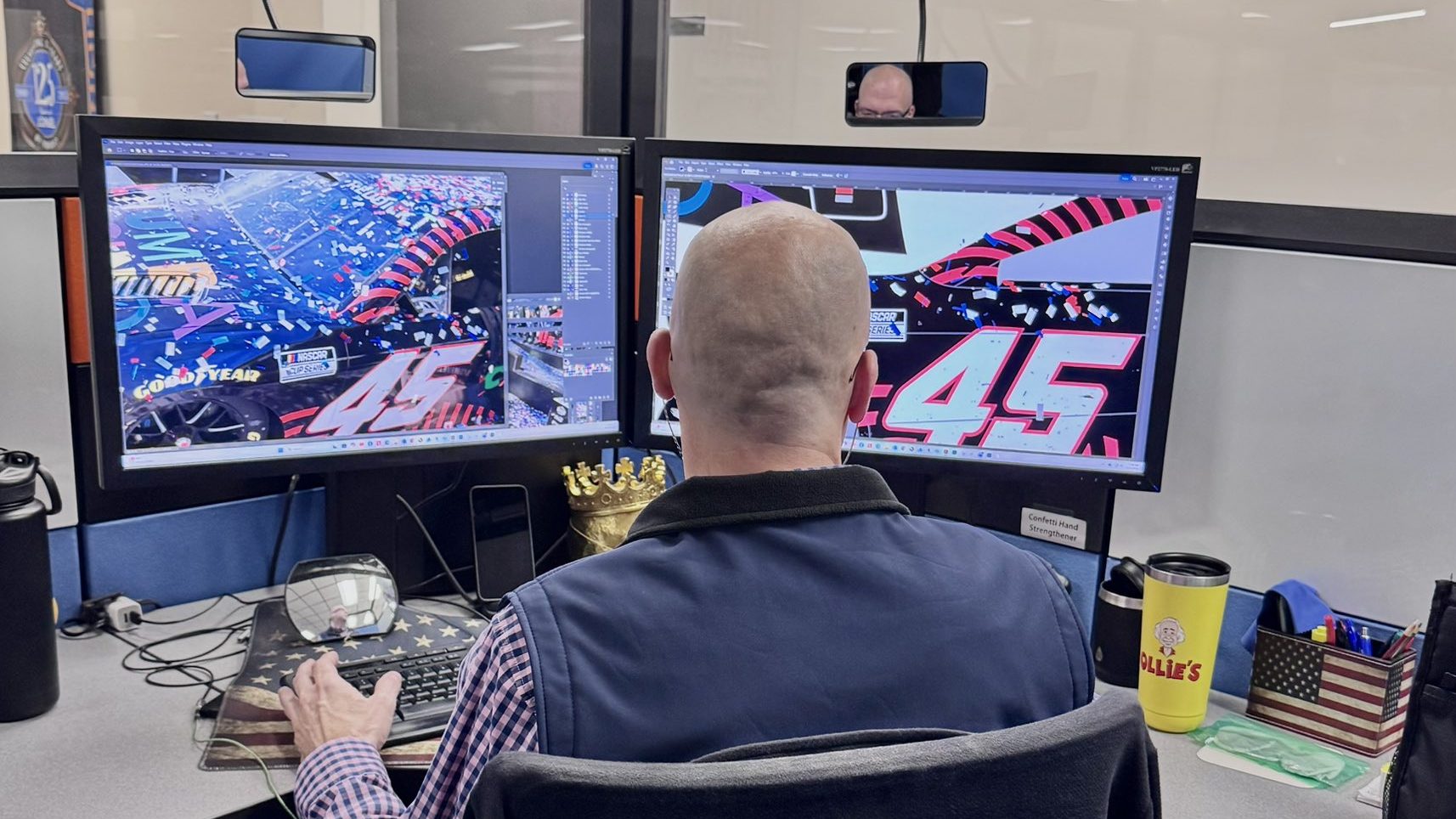
“From there, I add details that can be created as vector elements in Illustrator, like rivets, body lines, cameras, vents, and confetti,” Bluhm said. “Once that’s in place, I move into Photoshop to add dirt, tire rubs, body dents, and more detailed damage. After everything is finished, I bring it into 3D to set up the final renders. Using 3D as a tool helps dial everything in. Every artist has their own approach, but I work in the same order each time. I start at the driver’s side nose, move toward the TV panel, continue around the rear and up the passenger side back to the nose, then finish with the wheels, tires, and windows.”
The process of creating and placing every scrap of confetti, rubber mark or scratch takes about four or five days, Bluhm said. However, the amount of confetti or damage can “definitely affect that timeline,” sometimes adding several days to the process.

Meanwhile, the artist also works with other Lionel Racing staff.
“The Raced Win art is coordinated between me, the production manager assigned to the winning team, and the artist that is tasked with the project,” Kenfield said. “Once I determine which artist is available for each win, I’ll provide them with the photos that our photographers have taken and, along with the production manager, we will put together any notes on the win for the artist to keep in mind when creating the art. Of course, we encourage teamwork, so each artist can rely on the rest of the team for tricks, pointers, or examples of how we’ve done things before to bring the art to life the best way possible.”
Ultimately, there are still limitations to recreating a car exactly as it appeared post-race.
“We’ve worked with our factory to add some more three-dimensional damage to our cars over recent years,” Kenfield said. “Yes, the vast majority of the marks on a car can and will be replicated through decoration. But sometimes drivers will shred tires during a burnout, rip off fenders, or sometimes tear apart whole panels of the car through the course of the race. In the past few years, we’ve been able to get rear quarter panels to be cut, developed flattened and shredded rubber tires, and more, to add those special details to our Raced Wins. That said, sometimes there is damage that would require us to essentially damage a tool, thus rendering it unusable for future projects.”
Kenfield said these tools are hefty investments, and creating extensive body damage can render a mold useless for any other application. This would likely cause delays on manufacturing other cars, he added.
“But we’re always trying to find new ways to replicate damage to make it as authentic as possible,” he said. “We were able to work with our factory to find a way to cut out the left-front fender of the Justin Allgaier No. 40 Traveller Whiskey Raced Version car last year. It was the first time we had that much authentic damage on a car since the late 1990’s. Again, there are a lot of factors and limitations involved with what we can feasibly recreate. For that Allgaier car, each fender was cut out one-by-one in a somewhat manual process, but that program and story was well worth the effort. Doing that for the Allgaier car has opened the door to perhaps doing it again for a win car if and when the opportunity arises.”
Once the digital art is created, the production manager seeks approvals from the winning team. If there are changes required, the artwork is updated before production begins.

“If it’s outside of our control, we work directly with the factory and provide clear directions, so the finished product better matches the art that was approved by the team,” Bluhm said. “It’s always a big ego boost when you see a prototype come back looking perfect, especially when it’s a car that was executed in one shot, without any pre-production revisions or changes after the prototype stage.”
Once the artwork is finalized, the full production phase starts. This process takes several weeks, Kenfield said, followed by several more weeks on a cargo ship across the Pacific.
“Once they arrive to our warehouse, they’re shipped out for fans to enjoy,” he said.

Leave a Reply